
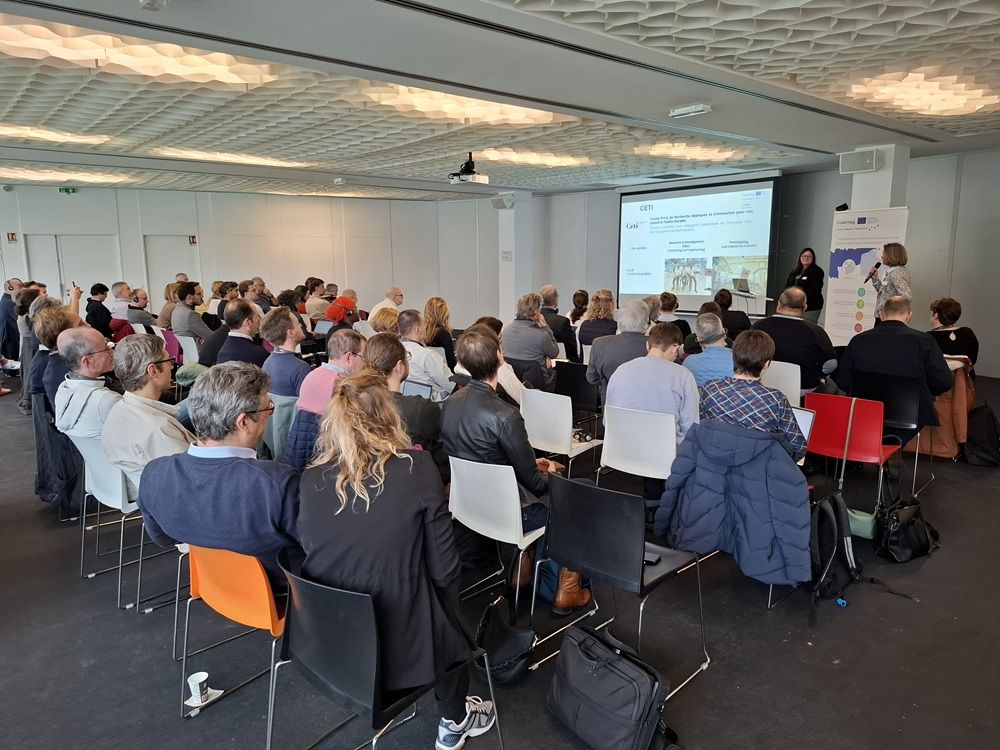
The Interreg Flanders-Wallonia-France project “Re-Aps” aims to implement the recycling of textile polyester on an industrial scale. On March 11, 2025, more than 90 participants were present in Tourcoing for the launch event.
Each year, 5 million tonnes of clothing are thrown away in the EU (12 kg per person). Polyester represents 54% of the 116 million tonnes of fibers produced in 2023.
On Tuesday, March 11, the launch event of “Re-Aps” brought together in Tourcoing more than 70 representatives of French and Belgian companies, around a single theme: the circularity of polyester textiles.
In concrete terms, the objective of the European project is to facilitate, on an industrial scale, the recycling of polyester waste via a thermomechanical process consisting of pre-treating, grinding, melting this waste and reusing it in the textile industry.
With a budget of nearly 1.5 million euros over a period of 4 years, it is part of the dual European ambition of resource saving and carbon neutrality of the Green Deal while contributing to the European strategy for sustainable and circular textiles.
EuraMaterials presented the state of the art and the regulatory context, such as the obligation to collect textile waste separately, extended producer responsibility (EPR) and considerations regarding product traceability and labeling.
The research centers Centexbel (BE) and CETI (FR) jointly presented the operating method for characterizing, preparing and transforming polyester waste streams, the technical conditions for industrial scaling up, as well as the creation of new opportunities at the local level through innovation in recycling.
In addition, Fedustria, together with all partners, has launched an appeal to all actors in the value chain (collectors, textile and plastics industries, polyester users, etc.) to contribute to the construction of a new textile sector.
All stakeholders were given the opportunity to speak, considering the importance of network dynamics.
Finally, the participants took advantage of the networking opportunity to visit the Ceti laboratory, the private center for applied research and innovation for a sustainable textile industry.
This cross-border approach aims not only to support sustainable development and create jobs, but also to redefine textile waste management in Europe.